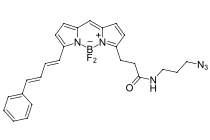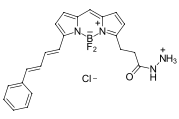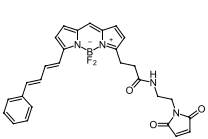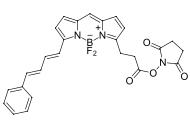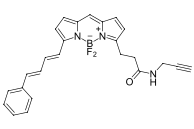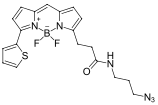
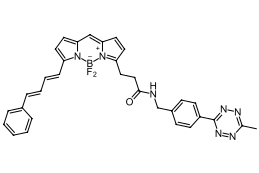
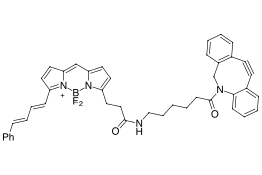
BDP 581/591 DBCO is a borondipyrromethene dye with a conjugated olefinic system and a DBCO (dibenzocyclooctyne) group. The DBCO moiety reacts with azides to form stable triazole conjugates. As a result, researchers can attach this fluorophore to azide-tagged molecules through copper-free click chemistry. In addition, the BDP 581/591 core can act as a probe for reactive oxygen species, because oxidation shifts its fluorescence toward green.
Key Features and Benefits
- Borondipyrromethene Fluorophore: The BDP 581/591 core contains a conjugated olefinic system and also works as a regular fluorescent label.
- Oxidation-Sensitive Fluorescence: After oxidation, the dye’s fluorescence moves to the green part of the spectrum, which supports ROS detection.
- DBCO Reactive Group: The strained cyclooctyne reacts with azides and, in turn, yields stable triazole conjugates.
- Copper-Free Click Chemistry: Strain-promoted azide–alkyne cycloaddition generally proceeds without copper, so no metal catalyst needs to be added.
- Flexible Pack Sizes: The reagent comes in 1 mg, 5 mg, 10 mg, 25 mg, 50 mg, and 100 mg units.
Applications
- Fluorescent Labeling: The dye serves as a regular fluorophore, so it can label azide-modified targets through its DBCO group.
- Reactive Oxygen Species Detection: The BDP 581/591 core acts as a ROS probe because oxidation shifts its emission toward green.
- Copper-Free Bioconjugation: In general, DBCO reagents are widely used to label azide-tagged proteins, peptides, and nucleic acids.
- Azide Detection Workflows: Similarly, DBCO-functionalized dyes are commonly used to detect azide groups introduced into biomolecules.
Storage and Handling
- Storage: Store according to supplier specifications. As general practice, keep fluorescent dyes dry and protected from light.
- Handling: Let the vial reach room temperature before opening to limit condensation. Also, avoid sodium azide buffers, because azides consume DBCO.
- Preparation: Dissolve the dye in a compatible dry solvent as directed by the supplier, then add it to the azide-containing sample.
- Conjugation and Analysis: After the click reaction, remove unreacted dye by gel filtration, dialysis, or HPLC. Then confirm labeling by fluorescence measurement.
In summary, BDP 581/591 DBCO combines a borondipyrromethene fluorophore with an azide-reactive DBCO group. It supports copper-free click labeling of azide-modified molecules. In addition, its oxidation-sensitive core suits reactive oxygen species studies alongside conventional fluorescent labeling workflows.
AxisPharm offers 5000+ PEG Linkers with high purity. Different kinds of PEG Reagents may be available by custom synthesis.