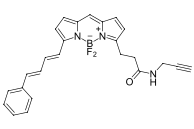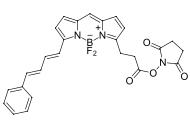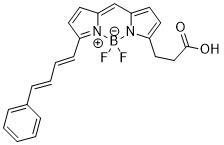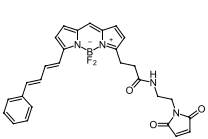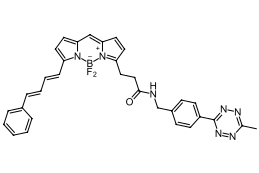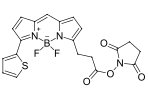
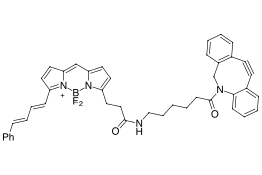
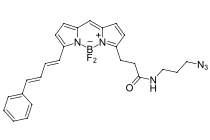
BDP 581/591 azide is an azide derivative of BDP 581/591, a bright and versatile boron-dipyrromethene fluorophore. The dye combines high brightness with a significant two-photon cross-section and a relatively long fluorescence lifetime. In addition, its azide group supports click conjugation to alkyne-modified small molecules and biomolecules. As a result, researchers can build tracers for fluorescence polarization assays and probes for fluorescence microscopy.
Key Features and Benefits
- High Brightness: BDP 581/591 is a bright fluorophore, so it suits sensitive fluorescence detection in labeling work.
- Two-Photon Cross-Section: The dye also has a significant two-photon cross-section, which makes it relevant to two-photon excitation experiments.
- Long Fluorescence Lifetime: Its relatively long fluorescence lifetime matters for fluorescence polarization and lifetime-based measurements.
- ROS-Responsive Fluorescence: The parent dye reacts with reactive oxygen species, and its fluorescence changes as a result.
- Azide Click Handle: Azides react with terminal alkynes by copper-catalyzed cycloaddition and with strained cyclooctynes without copper.
- Hydrophobic Character: The fluorophore is relatively hydrophobic; therefore, solvent choice and conjugate design deserve attention.
Applications
- Fluorescence Polarization Tracers: Researchers conjugate the azide to small molecules or biomolecules to construct tracers for fluorescence polarization assays.
- Microscopy Probes: Similarly, click conjugation to targeting molecules yields fluorescent probes for microscopy studies.
- Intracellular ROS Monitoring: Because BDP 581/591 changes its fluorescence on reaction with ROS, it supports intracellular ROS monitoring.
- Click Chemistry Labeling: Fluorescent azides are widely used to label alkyne-tagged proteins, nucleic acids, and metabolites.
Storage and Handling
- Storage: Store according to supplier specifications; as general practice, protect fluorescent dyes from light and moisture.
- Handling: Keep the dye away from oxidants and avoid phosphines or strong reducing agents, which can reduce azides.
- Preparation: Because the dye is relatively hydrophobic, dissolve it in a compatible organic solvent before adding aqueous buffer.
- Conjugation and Analysis: Use a ligand-stabilized copper(I) catalyst or a cyclooctyne partner, then purify and confirm conjugates by chromatography and spectroscopy.
BDP 581/591 azide pairs a bright, relatively hydrophobic fluorophore with an azide group for click conjugation. Its two-photon cross-section and long fluorescence lifetime support fluorescence polarization tracers and microscopy probes. In addition, the ROS-responsive fluorescence of the parent dye suits intracellular ROS monitoring research.
AxisPharm offers 5000+ PEG Linkers with high purity. Different kinds of PEG Reagents may be available by custom synthesis.