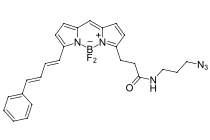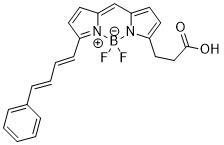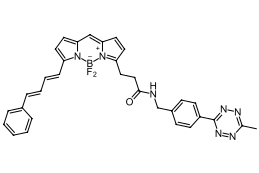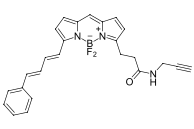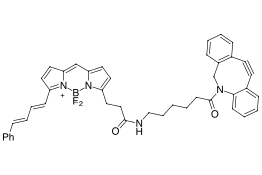
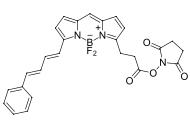
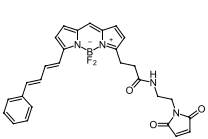
BDP 581/591 maleimide is a thiol-reactive fluorescent dye built on a borondipyrromethene (BDP) core. Its maleimide group couples with sulfhydryl groups, so researchers use it to label proteins and peptides. In addition, the dye suits fluorescence microscopy and fluorescence polarization experiments. Upon reaction with reactive oxygen species (ROS), the dye changes its fluorescence, which also supports ROS detection studies.
Key Features and Benefits
- Thiol-Reactive Maleimide: The maleimide group reacts with free sulfhydryl groups to form a thioether linkage.
- Selective Cysteine Labeling: Because free cysteines are often scarce in proteins, maleimide chemistry generally gives more selective labeling than amine-reactive dyes.
- BDP Fluorophore Core: BDP dyes belong to the boron-dipyrromethene class, which is generally known for narrow absorption and emission bands.
- ROS-Responsive Fluorescence: The dye changes its fluorescence after reacting with ROS, so it can report on oxidizing conditions.
- Flexible Unit Sizes: Units of 1 mg, 5 mg, 25 mg, 50 mg and 100 mg suit both pilot and larger experiments.
Applications
- Protein and Peptide Labeling: Researchers attach the dye to sulfhydryl groups to prepare fluorescent protein and peptide conjugates.
- Fluorescence Microscopy: Labeled conjugates then allow researchers to visualize target biomolecules by fluorescence microscopy.
- Fluorescence Polarization: The dye supports fluorescence polarization experiments, a format that commonly monitors molecular binding.
- ROS Detection: Because its fluorescence changes upon reaction with ROS, the dye also supports reactive oxygen species detection.
Storage and Handling
- Storage: Store according to supplier specifications. As general practice, keep the dye dry, sealed and protected from light.
- Handling: Let the vial reach room temperature before opening, because condensed moisture can hydrolyze maleimide groups.
- Preparation: Maleimide dyes are typically dissolved in a dry organic solvent, such as anhydrous DMSO, shortly before use.
- Conjugation and Analysis: Thiol-maleimide coupling usually works best near pH 6.5–7.5. Remove thiol reducing agents such as DTT first, then purify conjugates by gel filtration.
In summary, BDP 581/591 maleimide combines a BDP fluorophore with a thiol-reactive maleimide group. It supports sulfhydryl labeling of proteins and peptides, fluorescence microscopy and fluorescence polarization experiments. Moreover, its fluorescence response to ROS makes it a useful probe for ROS detection workflows.
AxisPharm offers 5000+ PEG Linkers with high purity. Different kinds of PEG Reagents may be available by custom synthesis.