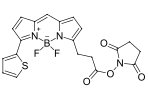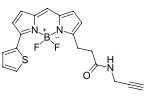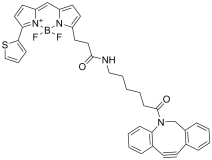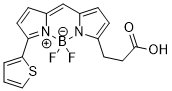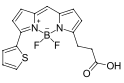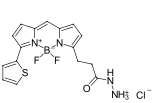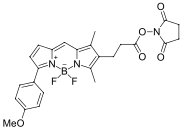
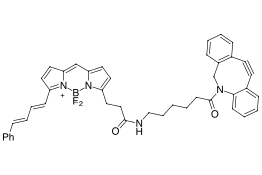
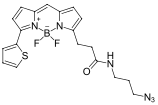
BDP 558/568 azide is a borondipyrromethene (BDP) fluorescent dye that carries a reactive azide group for click chemistry. Because its spectra are close to the Cyanine3 channel, it fits workflows that already use Cyanine3 detection. In addition, the azide reacts with alkynes, so researchers can attach the dye to many molecules of interest. As a result, it serves as a versatile building block for fluorescent conjugates and custom probes.
Key Features and Benefits
- Borondipyrromethene Fluorophore: The BDP core provides fluorescence, and this fluorophore has also been used for lipid tracking as BDP 558/568 C12.
- Cyanine3-Like Spectra: Its spectra lie close to the Cyanine3 channel, so researchers can consider existing Cyanine3 detection setups.
- Azide Click Handle: In general, organic azides react with terminal alkynes through copper-catalyzed azide–alkyne cycloaddition (CuAAC).
- Copper-Free Compatibility: Azides also react with strained cyclooctynes such as DBCO or BCN, therefore copper can be avoided.
- Stable Triazole Linkage: Both click routes form a 1,2,3-triazole, which typically gives a robust covalent connection.
- Bioorthogonal Selectivity: Azides rarely react with native groups in biomolecules, so labeling generally stays selective.
Applications
- Click Chemistry Labeling: Azide dyes are widely used to label alkyne-modified proteins, peptides, and oligonucleotides.
- Fluorescent Probe Synthesis: Similarly, chemists couple azide fluorophores to alkyne-bearing small molecules to build custom probes.
- Lipid Probe Development: Since the BDP 558/568 fluorophore has served in lipid tracking, its azide form allows coupling to alkyne-tagged lipids.
- Copper-Free Conjugation: In addition, strain-promoted reactions with DBCO or BCN partners suit samples where copper is undesirable.
- Fluorescence Imaging and Assays: Conjugates of this dye class can then be detected near the Cyanine3 channel.
Storage and Handling
- Storage: Store according to supplier specifications. As general practice, protect fluorescent dyes from light and moisture.
- Handling: Let the vial reach room temperature before opening. Also avoid phosphines and strong reducing agents, which can reduce azides.
- Preparation: BDP dyes are often hydrophobic, so confirm a compatible solvent before preparing stock solutions.
- Click Reaction and Analysis: For CuAAC, use a copper(I) source with a stabilizing ligand. Afterward, remove free dye and check labeling by fluorescence or HPLC.
BDP 558/568 azide combines a borondipyrromethene fluorophore with an azide click handle. Its spectra lie close to the Cyanine3 channel, which supports familiar detection setups. Consequently, it suits click labeling, custom probe synthesis, and lipid probe development in fluorescence-based research workflows.
AxisPharm offers 5000+ PEG Linkers with high purity. Different kinds of PEG Reagents may be available by custom synthesis.