


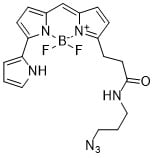

ATT 594 Azide is a red fluorescent dye designed for click chemistry, biomolecular labeling, and fluorescence imaging research. It features a rhodamine-based fluorophore with a reactive azide group that enables selective conjugation with alkyne-functionalized molecules. Its red fluorescence supports molecular detection, fluorescence microscopy, and biological imaging applications. Additionally, the azide functionality enables covalent attachment to compatible proteins, peptides, oligonucleotides, and other biomolecules through bioorthogonal click chemistry.
Key Features and Benefits
- Red Fluorescent Dye: Exhibits typical absorption near 603 nm and emission near 624 nm, supporting fluorescence detection in the red spectral region.
- Reactive Azide Functional Group: Provides a chemical handle for selective conjugation with suitable alkyne-functionalized molecules.
- Click Chemistry Compatibility: Supports copper-catalyzed azide–alkyne cycloaddition (CuAAC) and strain-promoted azide–alkyne cycloaddition (SPAAC) reactions.
- Rhodamine-Based Fluorophore: Features a fluorescent molecular structure suitable for optical detection and biomolecular labeling applications.
- Stable Triazole Formation: Enables covalent attachment through stable triazole linkages with compatible alkyne-containing compounds.
- Biomolecular Labeling Capability: Specifically supports fluorescent modification of proteins, peptides, oligonucleotides, and other suitably functionalized biomolecules.
- Fluorescence Imaging Compatibility: Supports detection using fluorescence microscopes and analytical instruments equipped with appropriate excitation and emission settings.
- Site-Specific Labeling Potential: Enables selective fluorescent conjugation at molecular sites containing compatible alkyne or strained alkyne groups.
- Research Versatility: Additionally, supports development of fluorescent molecular probes for chemical biology, cellular imaging, and bioconjugation research.
Applications
- Click Chemistry Bioconjugation: Enables covalent attachment of fluorescent labels to alkyne-functionalized biomolecules through compatible CuAAC or SPAAC reactions.
- Fluorescent Protein Labeling: Supports fluorescent modification of proteins containing suitable alkyne or strained alkyne groups.
- Peptide Labeling: Facilitates preparation of fluorescent peptide conjugates for biochemical assays and molecular interaction studies.
- Fluorescence Microscopy: Specifically supports visualization of labeled biomolecules using compatible red fluorescence detection systems.
- Oligonucleotide Labeling: Enables fluorescent conjugation with alkyne-functionalized DNA and RNA for nucleic acid research.
- Cellular Imaging Research: Supports investigation of fluorescently labeled biomolecule localization and distribution in compatible cellular systems.
- Bioorthogonal Labeling: Facilitates selective molecular labeling through suitable azide–alkyne cycloaddition chemistry.
- Fluorescent Molecular Probe Development: Additionally, supports preparation of specialized fluorescent probes for molecular detection and chemical biology research.
- Biomolecular Interaction Studies: Enables investigation of molecular binding, localization, and cellular interactions using fluorescence-based analytical methods.
Storage and Handling
- Storage: Store at −20°C in a dry, tightly sealed container, protected from light and moisture, unless product-specific instructions indicate otherwise. Additionally, minimize temperature fluctuations to preserve dye stability.
- Handling: Use clean, dry equipment and appropriate protective gear. Prepare solutions in compatible solvents, such as DMSO or DMF, after confirming solubility.
- Click Chemistry Conjugation: React the azide group with suitable terminal alkynes using CuAAC or strained alkynes using SPAAC chemistry. Subsequently, optimize reaction conditions while minimizing unnecessary light exposure.
- Purification and Analysis: Remove unreacted dye using chromatography or other suitable purification methods. Evaluate conjugation efficiency, fluorescence intensity, and product purity using HPLC, LC-MS, or appropriate analytical techniques.
ATT 594 Azide combines red fluorescence with reactive azide functionality for selective molecular labeling and bioconjugation. Its fluorescent structure supports optical detection, while the azide group enables covalent attachment to compatible alkyne-containing molecules. Therefore, it provides a versatile labeling reagent for click chemistry, protein and peptide modification, fluorescence microscopy, and chemical biology research.
AxisPharm offers 5000+ PEG Linkers with high purity. Different kinds of PEG Reagents may be available by custom synthesis.


