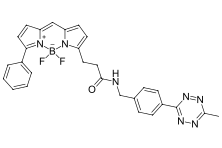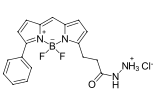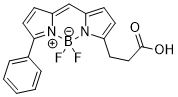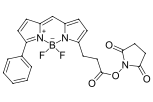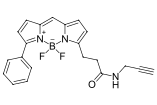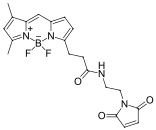
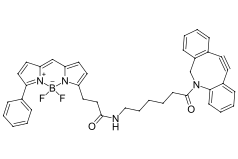
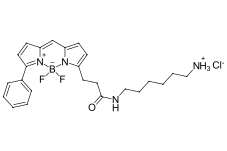
BDP R6G amine is a borondipyrromethene (BDP) fluorescent dye that matches the rhodamine 6G (R6G) detection channel. This derivative carries an aliphatic amine group, supplied in salt form. As a result, the amine serves as a nucleophilic handle for coupling with electrophiles. Researchers therefore use it to attach a BDP fluorophore to reactive molecules in labeling and probe synthesis workflows.
Key Features and Benefits
- Borondipyrromethene Core: The BDP scaffold belongs to a dye class generally valued for sharp emission bands and good photostability.
- R6G Channel Match: Its fluorescence matches the rhodamine 6G channel, so it fits existing R6G detection settings.
- Aliphatic Amine Group: The amine reacts with electrophiles and, in turn, enables covalent attachment to many reactive partners.
- Salt Form: The amine comes as a salt; consequently, coupling reactions may need mild base to free the reactive amine.
- Enzymatic Compatibility: In addition to chemical coupling, the amine can also take part in enzymatic transamination.
- Flexible Pack Sizes: Units of 1 mg, 5 mg, 25 mg, 50 mg, and 100 mg suit both pilot work and larger studies.
Applications
- Activated Ester Labeling: Amine-functional dyes commonly react with NHS esters, forming stable amide bonds with the target molecule.
- Carboxylic Acid Conjugation: Similarly, carbodiimide activation allows amine dyes to label carboxyl-containing molecules and surfaces.
- Reductive Amination: Amines also condense with aldehydes; subsequent reduction then gives a stable secondary amine linkage.
- Enzymatic Labeling: Amine dyes can also act as substrates in enzyme-mediated transamination labeling strategies.
- Fluorescent Probe Synthesis: Finally, chemists use amine-bearing fluorophores as building blocks for custom fluorescent probes.
Storage and Handling
- Storage: Store according to supplier specifications; as general practice, keep fluorescent dyes dry and protected from light.
- Handling: Allow the vial to reach room temperature before opening, because this limits moisture condensation.
- Preparation: Select a solvent compatible with the reaction partner; however, confirm dye solubility on a small scale first.
- Conjugation and Analysis: Avoid amine-containing buffers such as Tris, since they compete for electrophiles. Then purify conjugates by chromatography and confirm them by absorbance or mass spectrometry.
BDP R6G amine combines a borondipyrromethene fluorophore with an aliphatic amine in salt form. It supports coupling with electrophiles as well as enzymatic transamination. Consequently, it offers a practical way to introduce R6G-channel fluorescence into labeled molecules and custom probes.
AxisPharm offers 5000+ PEG Linkers with high purity. Different kinds of PEG Reagents may be available by custom synthesis.