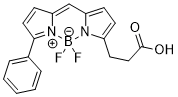
BDP R6G tetrazine is a fluorescent labeling reagent that combines a borondipyrromethene dye with a reactive tetrazine group. The BDP R6G fluorophore has absorption and emission wavelengths close to rhodamine 6G (R6G). In addition, the dye is very bright and photostable. Its tetrazine fragment reacts with trans-cyclooctenes, acylazetines, and other strained olefins, so researchers can attach the dye to dienophile-tagged molecules.
Key Features and Benefits
- Borondipyrromethene Fluorophore: The BDP R6G core is a borondipyrromethene dye with spectral properties close to rhodamine 6G.
- High Brightness: BDP R6G is a very bright dye, so it provides strong fluorescence signals from labeled molecules.
- Photostability: The dye is also photostable, which helps limit signal loss during repeated illumination.
- Tetrazine Reactive Group: The tetrazine acts as an electron-poor diene in inverse electron demand Diels–Alder reactions.
- Strained Olefin Partners: In turn, the tetrazine reacts with trans-cyclooctenes, acylazetines, and other strained olefins.
- Catalyst-Free Ligation: Tetrazine ligations generally proceed without copper or other metal catalysts.
Applications
- Click Chemistry Labeling: Tetrazine dyes are widely used to label trans-cyclooctene-modified molecules through inverse electron demand Diels–Alder reactions.
- Biomolecule Labeling: Similarly, tetrazine–TCO chemistry is commonly used to tag proteins, peptides, and nucleic acids carrying strained alkenes.
- Bioorthogonal Labeling: Because tetrazine ligation is bioorthogonal, researchers often apply tetrazine dyes in complex biological samples.
- Fluorescence-Based Assays: Bright, photostable fluorophores are also useful as reporters in fluorescence-based biochemical assays.
Storage and Handling
- Storage: Store according to supplier specifications. As general practice, protect fluorescent dyes from light and moisture.
- Handling: Allow the vial to reach room temperature before opening to limit condensation. Also, minimize light exposure during weighing.
- Preparation: Select a solvent according to supplier guidance. Because tetrazines can degrade under some conditions, prepare solutions shortly before use.
- Conjugation and Analysis: React the dye with the strained olefin-tagged partner, then remove excess dye by dialysis, size exclusion, or HPLC. Finally, confirm labeling by absorbance, fluorescence, or mass spectrometry.
BDP R6G tetrazine pairs a bright, photostable borondipyrromethene fluorophore with a tetrazine group for inverse electron demand Diels–Alder chemistry. As a result, it supports click chemistry labeling of trans-cyclooctene and strained olefin-tagged molecules. Researchers can therefore add rhodamine 6G-like fluorescence to biomolecules in bioconjugation workflows.
AxisPharm offers 5000+ PEG Linkers with high purity. Different kinds of PEG Reagents may be available by custom synthesis.