


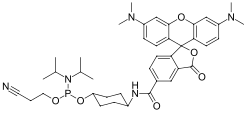

TAMRA NHS ester, 5-isomer is an amine-reactive form of tetramethylrhodamine, a xanthene dye of the rhodamine series. This isomerically pure 5-TAMRA reagent carries an N-hydroxysuccinimide (NHS) ester that couples to primary amines. TAMRA has long been used in dual-labeled qPCR oligonucleotide probes paired with fluorescein (FAM). In addition, the reagent supports labeling of proteins, peptides, and amine-modified oligonucleotides.
Key Features and Benefits
- Isomerically Pure 5-TAMRA: The product contains only the 5-isomer, so conjugates carry a single defined dye structure.
- Amine-Reactive NHS Ester: In general, NHS esters react with primary amines to form a stable amide bond.
- Rhodamine Xanthene Fluorophore: TAMRA belongs to the rhodamine series of xanthene dyes, a well-characterized fluorophore class.
- Familiar Optical Behavior: The 5- and 6-isomers have nearly identical optical properties, so 5-TAMRA matches established TAMRA labels.
- Simplified Analysis: Because only one isomer is present, chromatographic purification and characterization of conjugates can be simpler.
- Established Probe Chemistry: TAMRA also has a long history in dual-labeled qPCR probes alongside FAM.
Applications
- Dual-Labeled qPCR Probes: TAMRA pairs with FAM in dual-labeled oligonucleotide probes for real-time PCR.
- Oligonucleotide Labeling: The NHS ester reacts with amine-modified oligonucleotides, for example at amino-linker sites.
- Protein Labeling: Lysine side chains and N-terminal amines provide attachment sites for fluorescent protein labeling.
- Peptide Labeling: Similarly, peptides with free amine groups can carry the TAMRA fluorophore for detection.
- Fluorescent Assays: Rhodamine-labeled biomolecules are widely used in fluorescence-based biochemical assays.
Storage and Handling
- Storage: Store according to supplier specifications; as general practice, keep NHS ester dyes dry and protected from light.
- Handling: Equilibrate the vial to room temperature before opening, because condensed moisture hydrolyzes NHS esters.
- Preparation: NHS ester dyes are typically dissolved in an anhydrous, amine-free organic solvent shortly before use.
- Labeling and Analysis: Use amine-free buffers at slightly basic pH, avoiding Tris or glycine; then remove free dye by gel filtration, dialysis, or HPLC.
TAMRA NHS ester, 5-isomer combines a single-isomer rhodamine fluorophore with amine-reactive NHS ester chemistry. It suits labeling of proteins, peptides, and amine-modified oligonucleotides, including dual-labeled qPCR probes with FAM. As a result, researchers can prepare defined TAMRA conjugates for fluorescence-based workflows.
AxisPharm offers 5000+ PEG Linkers with high purity. Different kinds of PEG Reagents may be available by custom synthesis.


