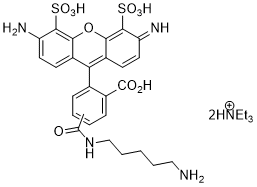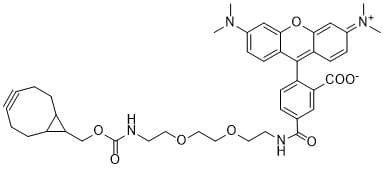

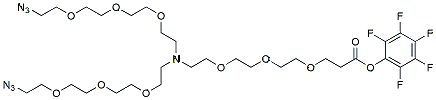


Pacific Blue NHS Ester is an amine-reactive, blue fluorescent dye designed for protein labeling, antibody conjugation, and fluorescence-based biological research. It combines a violet-excitable fluorophore with an N-hydroxysuccinimide (NHS) ester group that reacts with primary amines to form stable covalent amide bonds. Its bright blue fluorescence supports flow cytometry, fluorescence microscopy, and biomolecular detection. Additionally, its spectral properties make it suitable for multicolor fluorescence experiments involving compatible fluorophores.
Key Features and Benefits
- Blue Fluorescent Dye: Exhibits typical excitation near 410 nm and emission near 455 nm, providing bright blue fluorescence for molecular detection.
- Reactive NHS Ester Group: Enables covalent labeling of primary amines, including lysine residues and accessible N-terminal amino groups in proteins.
- Stable Amide Bond Formation: Reacts with suitable primary amines to form stable covalent linkages for fluorescent biomolecular conjugation.
- Violet Laser Compatibility: Supports excitation using 405 nm violet lasers commonly available in flow cytometry and fluorescence imaging systems.
- Protein Labeling Capability: Specifically enables fluorescent modification of antibodies, peptides, and other amine-containing biomolecules.
- Multicolor Fluorescence Compatibility: Offers relatively limited spectral overlap with many green and red fluorophores, supporting appropriately designed multicolor experiments.
- Fluorescence Detection Performance: Provides strong fluorescence emission in compatible environments, including near-neutral aqueous conditions.
- Bioconjugation Versatility: Supports labeling of proteins, amino-functionalized surfaces, and other molecules containing accessible primary amines.
- Research Flexibility: Additionally, enables development of fluorescent molecular probes for cellular imaging, immunoassays, and biomolecular interaction studies.
Applications
- Fluorescent Protein Labeling: Enables covalent attachment of blue fluorescent dye molecules to proteins containing accessible primary amines.
- Antibody Conjugation: Supports preparation of fluorescently labeled antibodies for immunofluorescence, flow cytometry, and biomolecular detection.
- Flow Cytometry: Provides violet-excitable fluorescent conjugates for cellular marker detection and multiparameter analysis.
- Fluorescence Microscopy: Specifically supports visualization of fluorescently labeled biomolecules in compatible cellular and tissue imaging systems.
- Peptide Labeling: Enables fluorescent modification of peptides containing suitable reactive amino groups.
- Immunofluorescence Assays: Supports preparation of fluorescent antibody conjugates for detecting specific antigens in biological samples.
- Biomolecular Interaction Studies: Facilitates investigation of protein localization, molecular binding, and biomolecular interactions using fluorescence detection.
- Multicolor Cell Imaging: Additionally, supports development of fluorescent probes for experiments combining blue, green, and red fluorescent labels.
- Fluorescence-Based Assay Development: Provides an amine-reactive fluorescent reagent for developing analytical assays, molecular probes, and protein detection methods.
Storage and Handling
- Storage: Store at −20°C in a dry, tightly sealed container, protected from light and moisture. Additionally, minimize temperature fluctuations to preserve NHS ester reactivity.
- Handling: Use clean, dry equipment and appropriate protective gear. Prepare fresh stock solutions in anhydrous DMSO or DMF, avoiding prolonged exposure to moisture.
- Bioconjugation: React with primary amines in a compatible, amine-free buffer at approximately pH 7–9. Subsequently, optimize dye-to-protein ratios and reaction conditions while avoiding Tris and other competing primary amines.
- Purification and Analysis: Remove excess dye using desalting, dialysis, or chromatography. Evaluate conjugation efficiency, fluorescence intensity, and product purity using appropriate analytical methods.
Pacific Blue NHS Ester combines violet-excitable blue fluorescence with amine-reactive NHS ester chemistry for selective biomolecular labeling. Its covalent conjugation capability supports preparation of fluorescent proteins, antibodies, peptides, and molecular probes. Therefore, it provides a versatile labeling reagent for flow cytometry, fluorescence microscopy, immunoassays, and multicolor fluorescence research.
AxisPharm offers 5000+ PEG Linkers with high purity. Different kinds of PEG Reagents may be available by custom synthesis.