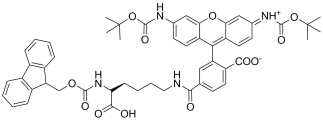
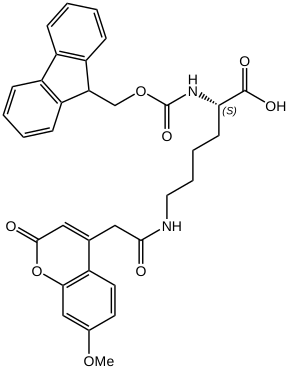
Fmoc-L-Lys(Mca)-OH is a fluorescent lysine derivative designed for solid-phase peptide synthesis (SPPS), peptide labeling, and fluorescence-based biochemical research. It features an Fmoc-protected α-amino group and a 7-methoxycoumarin-4-acetyl (Mca) fluorophore attached to the lysine side chain. The Fmoc group supports controlled peptide assembly, while the Mca moiety provides fluorescence for molecular detection and analytical studies. Additionally, this building block enables site-specific incorporation of fluorescent labels into synthetic peptides for protease assays, fluorescence quenching, and peptide interaction research.
Key Features and Benefits
- Fluorescent Amino Acid Building Block: Combines an Fmoc-protected L-lysine structure with a covalently attached Mca fluorophore for peptide synthesis.
- 7-Methoxycoumarin Fluorophore: Provides blue fluorescence with typical excitation near 325 nm and emission near 393 nm, depending on experimental conditions.
- Fmoc-Protected Amino Group: Supports controlled peptide chain assembly through standard Fmoc-based solid-phase peptide synthesis chemistry.
- Side-Chain Fluorescent Labeling: Specifically enables introduction of Mca fluorescence at defined lysine positions within synthetic peptide sequences.
- Solid-Phase Synthesis Compatibility: Supports incorporation into peptides using compatible Fmoc deprotection and amino acid coupling procedures.
- Fluorescence Quenching Compatibility: Enables preparation of fluorescent peptide substrates containing suitable quenchers for fluorescence resonance energy transfer (FRET) or related quenching assays.
- Protease Substrate Development: Supports synthesis of fluorogenic peptide substrates for investigating enzyme activity and peptide cleavage.
- Covalent Fluorophore Attachment: Maintains the Mca label on the lysine side chain through an amide linkage for fluorescent peptide preparation.
- Biochemical Research Versatility: Additionally, supports fluorescent peptide probe development, enzyme assays, and molecular interaction studies.
Applications
- Fluorescent Peptide Synthesis: Enables incorporation of Mca-labeled lysine residues into synthetic peptides using compatible Fmoc-based SPPS protocols.
- Protease Activity Assays: Supports preparation of fluorescent peptide substrates for monitoring protease-mediated cleavage and enzymatic activity.
- FRET-Based Peptide Substrates: Specifically enables development of peptide substrates containing Mca fluorophores and compatible quenching groups for fluorescence-based cleavage assays.
- Peptide Labeling Research: Provides a fluorescent amino acid building block for site-specific labeling of synthetic peptides.
- Enzyme Kinetics Studies: Supports investigation of protease activity, substrate specificity, and enzymatic cleavage rates using suitable fluorescent substrates.
- Fluorescence Quenching Assays: Enables preparation of peptide probes that generate measurable fluorescence changes following cleavage or molecular interactions.
- Peptide Interaction Studies: Facilitates investigation of peptide binding, molecular recognition, and conformational behavior using fluorescence detection.
- Fluorescent Molecular Probe Development: Additionally, supports synthesis of specialized peptide probes for chemical biology and biochemical analysis.
- Peptide Structure–Function Research: Enables incorporation of fluorescent labels for investigating peptide behavior and structure-dependent molecular interactions.
Storage and Handling
- Storage: Store at −20°C in a dry, tightly sealed container, protected from light and moisture, unless product-specific instructions indicate otherwise. Additionally, minimize temperature fluctuations to preserve reagent stability.
- Handling: Use clean, dry equipment and appropriate protective gear. Prepare solutions in compatible peptide synthesis solvents, such as DMF or NMP, after confirming solubility.
- Peptide Synthesis: Incorporate into peptide sequences using compatible Fmoc-based SPPS protocols. Subsequently, optimize coupling, cleavage, and deprotection conditions to preserve Mca fluorescence.
- Fluorescence Analysis: Monitor Mca fluorescence using suitable excitation and emission settings. Evaluate peptide purity, labeling efficiency, and fluorescence response using HPLC, LC-MS, or other appropriate analytical methods.
Fmoc-L-Lys(Mca)-OH combines Fmoc-based peptide synthesis compatibility with a covalently attached fluorescent coumarin group for site-specific peptide labeling. Its Mca functionality supports fluorescence detection, protease substrate development, and peptide interaction studies. Therefore, it provides a versatile building block for fluorescent peptide synthesis, enzyme activity assays, fluorescence quenching, and chemical biology research.
AxisPharm offers 5000+ PEG Linkers with high purity. Different kinds of PEG Reagents may be available by custom synthesis.