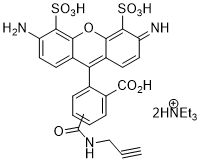
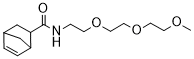
Eosin-5-Maleimide (Thiol-Reactive Fluorescent Dye) provides a fluorescent labeling reagent for selective modification of thiol-containing biomolecules and specifically combines an eosin-based xanthene fluorophore with a maleimide functional group that reacts with sulfhydryl groups to form covalent thioether linkages. This reagent supports protein labeling, cysteine modification, fluorescence microscopy, and bioconjugation research.
Key Features and Benefits
- Thiol-Reactive Maleimide Group: Enables covalent conjugation with free sulfhydryl groups on proteins, peptides, and other thiol-containing molecules.
- Eosin Fluorophore: Provides visible-light excitation and orange-red fluorescence for molecular labeling and detection applications.
- Cysteine-Selective Labeling: Supports modification of accessible cysteine residues under controlled reaction conditions.
- Covalent Bioconjugation: Forms thioether-linked conjugates through maleimide-thiol addition chemistry, supporting downstream fluorescence analysis.
- Visible-Light Fluorescence: Offers fluorescence detection in the green-to-orange spectral region, with excitation and emission characteristics dependent on the experimental environment.
- Protein Labeling Compatibility: Supports fluorescent modification of proteins containing accessible free thiol groups.
- Sensitive Fluorescence Detection: Enables visualization and measurement of labeled biomolecules using compatible fluorescence instrumentation.
- Versatile Molecular Labeling: Supports conjugation with thiolated peptides, polymers, and other sulfhydryl-functionalized research materials.
- Research-Ready Functional Design: Combines a fluorescent reporter and thiol-reactive functionality in one molecule for biochemical labeling workflows.
Applications
- Protein Fluorescent Labeling: Enables covalent attachment of eosin fluorescence to proteins containing accessible cysteine residues.
- Cysteine Modification Studies: Supports investigation of thiol accessibility, cysteine reactivity, and protein structural changes.
- Peptide Bioconjugation: Enables fluorescent labeling of cysteine-containing peptides for molecular interaction and analytical studies.
- Fluorescence Microscopy: Supports visualization of appropriately labeled biomolecules using compatible excitation and emission filters.
- Protein Structure Research: Facilitates investigation of conformational changes and thiol accessibility through fluorescence-based measurements.
- Biochemical Assay Development: Supports preparation of fluorescent conjugates for binding assays, molecular recognition studies, and analytical detection.
- Thiol Quantification Research: Enables investigation of accessible sulfhydryl groups through appropriately calibrated labeling and fluorescence measurements.
- Polymer Functionalization: Supports fluorescent modification of thiol-functionalized polymers and biomaterials.
- Fluorescence-Based Molecular Tracking: Enables monitoring of labeled proteins, peptides, and other conjugates in suitable experimental systems.
Storage and Handling
- Storage: Store at −20°C in a tightly sealed container, protected from light and moisture, unless otherwise specified. Minimize repeated exposure to room temperature and prolonged illumination to preserve fluorescence and maleimide reactivity.
- Handling: Prepare fresh solutions using a compatible solvent, such as DMSO or DMF, after confirming product-specific solubility. Protect solutions from direct light and minimize prolonged storage after preparation.
- For thiol labeling, use an appropriate aqueous buffer at approximately pH 6.5–7.5. Maleimide groups react efficiently with free sulfhydryl groups under mildly acidic to neutral conditions. Avoid prolonged exposure to alkaline conditions, which can promote maleimide hydrolysis and reduce conjugation efficiency.
- Avoid thiol-containing reducing agents, including DTT and β-mercaptoethanol, during labeling because they compete with the target biomolecule. If disulfide reduction is necessary, remove excess reducing agent before introducing the fluorescent reagent.
- Optimize dye-to-biomolecule ratios, reaction times, and purification procedures for the intended application. Remove unreacted dye using suitable purification methods, such as desalting, dialysis, or chromatography.
- Select fluorescence excitation and emission settings based on the product’s verified spectral properties. Eosin derivatives commonly exhibit excitation in the green region and emission in the yellow-orange region, but exact wavelengths depend on molecular structure, solvent, and pH. Account for fluorescence quenching and photobleaching during analysis.
Eosin-5-Maleimide (Thiol-Reactive Fluorescent Dye) combines eosin fluorescence with maleimide-mediated thiol conjugation for selective biomolecule labeling and specifically supports protein and peptide modification, cysteine accessibility studies, fluorescence microscopy, biochemical assay development, and fluorescent biomaterials research.
AxisPharm offers 5000+ PEG Linkers with high purity. Different kinds of PEG Reagents may be available by custom synthesis.