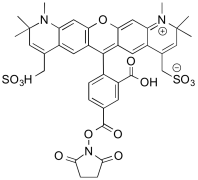
APDye 594 Tyramide is a red fluorescent tyramide reagent for tyramide signal amplification (TSA) in fluorescence imaging. It links the APDye 594 fluorophore to a tyramine-based substrate that horseradish peroxidase (HRP) activates. As a result, the dye deposits covalently near HRP-labeled targets, which helps researchers detect low-abundance targets. Typical workflows include multiplexed immunocytochemistry (ICC), immunohistochemistry (IHC), and in situ hybridization (ISH).
Key Features and Benefits
- HRP-Activated Tyramide: In the presence of low hydrogen peroxide levels, HRP converts the tyramide into a highly reactive radical.
- Covalent Local Deposition: The activated radical binds tyrosine residues at or near the HRP, so the signal stays close to the target.
- Signal Amplification: Because one HRP molecule can activate many tyramide molecules, TSA increases detection sensitivity.
- Red Fluorescent Label: The APDye 594 fluorophore provides a red signal for fluorescence microscopy and multicolor designs.
- HRP Antibody Compatibility: The reagent pairs with HRP-conjugated antibodies, so researchers can adapt existing detection workflows.
- Multiplex Support: In addition, its red emission fits multiplexed panels alongside fluorophores of other colors.
Applications
- Immunohistochemistry (IHC): Researchers use it to amplify weak antigen signals in tissue sections labeled with HRP-conjugated antibodies.
- Immunocytochemistry (ICC): Similarly, it supports sensitive fluorescent detection of low-abundance proteins in cultured cells.
- In Situ Hybridization (ISH): HRP-based detection with this tyramide helps visualize low-level nucleic acid targets in cells and tissues.
- FISH and Multicolor FISH: Red fluorescent tyramides are widely used for TSA in FISH and multicolor FISH studies.
- Multiplexed Fluorescence Imaging: Its red signal also complements other fluorophores in multiplexed ICC and IHC experiments.
Storage and Handling
- Storage: Store according to supplier specifications. As general practice for fluorescent dyes, protect from light and moisture.
- Handling: Allow the vial to reach room temperature before opening to limit condensation. Also, minimize light exposure during use.
- Preparation: Prepare working solutions as your TSA protocol specifies. Keep hydrogen peroxide low, because excess peroxide can inactivate HRP.
- Amplification and Analysis: Quench endogenous peroxidase activity first to reduce background. Then wash thoroughly and image with filters matched to APDye 594.
APDye 594 Tyramide combines a red fluorescent label with HRP-activated tyramide chemistry. Consequently, it supports signal amplification for low-abundance targets in IHC, ICC, and ISH. Researchers can apply it in multiplexed fluorescence workflows that rely on HRP-conjugated antibodies.
AxisPharm offers 5000+ PEG Linkers with high purity. Different kinds of PEG Reagents may be available by custom synthesis.