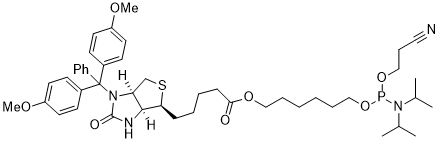



3′-O-DMTr-thymidine 5′-CE Phosphoramidite is a protected thymidine nucleotide building block designed for reverse-direction solid-phase DNA synthesis and oligonucleotide research. It features a 3′-O-dimethoxytrityl (DMTr) protecting group and a reactive 5′-O-(2-cyanoethyl) phosphoramidite functionality. Unlike conventional 3′-phosphoramidites, this reagent enables oligonucleotide assembly in the 5′-to-3′ direction using compatible reverse synthesis protocols. Additionally, its protected structure supports controlled nucleotide incorporation for specialized DNA synthesis, molecular probe development, and nucleic acid research.
Key Features and Benefits
- Reverse-Direction Phosphoramidite: Enables oligonucleotide synthesis in the 5′-to-3′ direction, providing an alternative to conventional 3′-to-5′ assembly.
- 3′-O-DMTr Protecting Group: Protects the 3′-hydroxyl group during synthesis while allowing controlled acid-mediated removal during successive coupling cycles.
- Reactive 5′-Phosphoramidite Group: Supports phosphoramidite coupling through the 5′ position of thymidine for reverse-direction DNA assembly.
- 2-Cyanoethyl Phosphate Protection: Provides temporary phosphate protection during oligonucleotide synthesis and supports subsequent removal under suitable deprotection conditions.
- Thymidine Building Block: Incorporates thymidine residues into synthetic DNA sequences through compatible reverse-direction synthesis chemistry.
- Solid-Phase Synthesis Compatibility: Specifically supports automated and manual oligonucleotide synthesis using validated reverse-direction phosphoramidite protocols.
- Controlled Nucleotide Incorporation: Enables precise placement of thymidine residues within synthetic DNA sequences through sequential coupling reactions.
- Specialized DNA Synthesis Capability: Supports preparation of oligonucleotides requiring reverse-direction assembly or specialized terminal modifications.
- Nucleic Acid Research Versatility: Additionally, provides a protected nucleotide building block for DNA probe development, modified oligonucleotide synthesis, and molecular biology research.
Applications
- Reverse-Direction DNA Synthesis: Enables preparation of synthetic DNA oligonucleotides through 5′-to-3′ solid-phase assembly.
- Automated Oligonucleotide Synthesis: Supports incorporation of thymidine residues using compatible automated reverse-direction synthesis platforms.
- Specialized DNA Oligonucleotide Preparation: Facilitates synthesis of DNA sequences requiring nonstandard assembly orientation or specific terminal functionalization.
- DNA Probe Development: Specifically supports preparation of thymidine-containing oligonucleotide probes for molecular detection and hybridization studies.
- Modified Oligonucleotide Synthesis: Enables incorporation into DNA sequences containing compatible modified nucleotides or specialized terminal groups.
- Reverse-Direction Primer Synthesis: Supports preparation of DNA primers using validated reverse-direction oligonucleotide synthesis protocols.
- DNA Hybridization Research: Enables synthesis of oligonucleotides for investigating complementary DNA interactions and sequence recognition.
- Nucleic Acid Assay Development: Additionally, supports preparation of synthetic DNA probes for analytical assays and molecular biology applications.
- Oligonucleotide Chemistry Research: Provides a specialized phosphoramidite building block for investigating reverse synthesis strategies and nucleotide coupling efficiency.
Storage and Handling
- Storage: Store at −20°C in a dry, tightly sealed container, protected from moisture and heat. Additionally, minimize temperature fluctuations to preserve phosphoramidite reactivity.
- Handling: Use clean, dry equipment and appropriate protective gear. Prepare solutions in anhydrous acetonitrile or another validated synthesis solvent under moisture-controlled conditions.
- Oligonucleotide Synthesis: Incorporate into DNA sequences using compatible 5′-to-3′ solid-phase phosphoramidite protocols. Subsequently, optimize coupling, oxidation, and detritylation conditions for efficient nucleotide incorporation.
- Deprotection and Analysis: Apply suitable cleavage and deprotection procedures to remove DMTr and phosphate protecting groups as required. Evaluate oligonucleotide identity, purity, and integrity using HPLC, LC-MS, or other validated analytical methods.
3′-O-DMTr-thymidine 5′-CE Phosphoramidite combines 3′-DMTr protection with reactive 5′-phosphoramidite functionality for specialized oligonucleotide synthesis. Its reverse-direction configuration enables controlled thymidine incorporation while supporting alternative DNA assembly strategies. Therefore, it provides a valuable nucleotide building block for reverse DNA synthesis, modified oligonucleotide preparation, molecular probe development, and nucleic acid research.
AxisPharm offers 5000+ PEG Linkers with high purity. Different kinds of PEG Reagents may be available by custom synthesis.