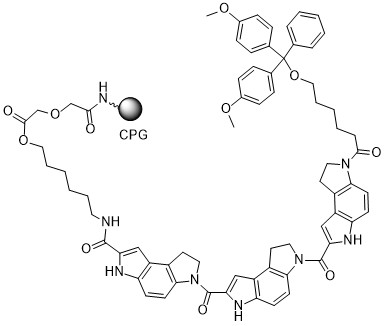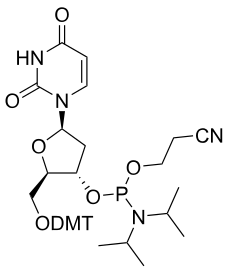


DusQ1 CPG 1000 is a controlled pore glass (CPG) solid support with a 1000 Å pore size, functionalized for 3′ DusQ1 labeling. It is intended for automated synthesis of oligonucleotides up to 120 bases that carry the DusQ1 dark quencher at the 3′ end. DusQ1 is non-fluorescent and absorbs most strongly between 480 and 580 nm, with a maximum at 534 nm. As a result, it suits the preparation of quenched hybridization probes for nucleic acid detection research.
Key Features and Benefits
- 1000 Å Pore Size: Wide pores give growing chains more room, so the support suits oligonucleotides up to 120 bases.
- 3′ DusQ1 Modification: Synthesis starts from the support, so each finished oligonucleotide carries DusQ1 at its 3′ end.
- Dark Quencher Chemistry: DusQ1 is non-fluorescent, therefore it does not add an emission signal of its own.
- Defined Absorption Range: DusQ1 absorbs most strongly from 480 to 580 nm, with its absorption maximum at 534 nm.
- Combined Quenching Mechanism: DusQ1 quenches through a combination of static and dynamic quenching.
- Broad Fluorophore Compatibility: In addition, DusQ1 quenches many fluorophores, including EDANS, FAM, TET, HEX and R6G.
- Automated Synthesis Format: The CPG support fits standard workflows for automated solid-phase oligonucleotide synthesis.
Applications
- Hydrolysis Probes: DusQ1 CPG 1000 supports the synthesis of 5′ nuclease (TaqMan-type) probes with a 3′ quencher.
- Molecular Beacons: Similarly, researchers can build hairpin probes that place DusQ1 at the 3′ terminus.
- Scorpion Primers: The support also suits Scorpion-format probes that combine primer and probe in one molecule.
- Dual-Labeled Oligonucleotides: In general, 3′ quencher supports pair with 5′ fluorophores to create quenched, signal-on probes.
- Longer Probe Sequences: Because of the 1000 Å pores, the support accommodates labeled oligonucleotides up to 120 bases.
Storage and Handling
- Storage: Store according to supplier specifications in a tightly closed container, protected from moisture and light as general practice.
- Handling: Let the container reach room temperature before opening, which limits moisture condensation on the glass.
- Preparation: Weigh or pack the support into synthesis columns suited to your synthesizer and synthesis scale.
- Synthesis and Analysis: Choose cleavage and deprotection conditions compatible with DusQ1, then characterize purified probes by HPLC and mass spectrometry.
In summary, DusQ1 CPG 1000 combines a 1000 Å controlled pore glass support with a 3′ DusQ1 dark quencher. It enables automated synthesis of quenched probes up to 120 bases, including hydrolysis probes, molecular beacons and Scorpion primers, for nucleic acid detection research.
AxisPharm offers 5000+ PEG Linkers with high purity. Different kinds of PEG Reagents may be available by custom synthesis.