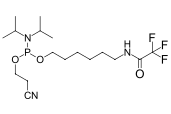
TFA-aminolinker C6 phosphoramidite introduces a primary amine at the 5′-terminus of synthetic oligonucleotides. The reagent combines a phosphoramidite coupling group, a six-carbon spacer, and a trifluoroacetyl (TFA) protected amine. During standard ammonia deprotection, the TFA group comes off without any additional steps. As a result, researchers obtain 5′-amino-modified oligonucleotides for DNA array production and later 5′-terminal modification with NHS esters.
Key Features and Benefits
- Phosphoramidite Coupling: Like other phosphoramidites, the reagent adds to the 5′-end of a growing oligonucleotide during automated synthesis.
- C6 Spacer: A six-carbon chain separates the amine from the oligonucleotide, which can ease access for later conjugation.
- TFA Amine Protection: The trifluoroacetyl group masks the amine, so it stays unreactive during chain assembly.
- One-Step Deprotection: Ammonia deprotection removes the TFA group smoothly, therefore no extra deprotection step is required.
- Reactive Primary Amine: After deprotection, the free 5′-amine reacts with NHS esters to form stable amide bonds.
- Flexible Purification: In addition, researchers can purify the amino-modified oligonucleotides by ion exchange chromatography or gel electrophoresis.
Applications
- 5′-Amino Oligonucleotide Synthesis: The reagent provides a direct route to 5′-amino-modified oligonucleotides on standard synthesizers.
- DNA Array Production: 5′-terminal amino-modified oligonucleotides serve as building blocks for the production of DNA arrays.
- NHS Ester Modification: The 5′-amine accepts labels and other groups supplied as NHS esters, for example dyes or biotin.
- Oligonucleotide Conjugate Research: Similarly, amine-modified oligonucleotides are widely coupled to other molecules through amine-reactive chemistry.
Storage and Handling
- Storage: Store according to supplier specifications; phosphoramidites are generally sensitive to moisture and oxidation, so keep containers tightly sealed.
- Handling: Let the container reach room temperature before opening to limit condensation, and work under dry conditions.
- Preparation: In general phosphoramidite practice, researchers dissolve the reagent in an anhydrous synthesis solvent; confirm the choice with supplier documentation.
- Deprotection and Analysis: Ammonia removes the TFA group, then ion exchange or gel electrophoresis purifies the product; use amine-free buffers for NHS ester coupling.
TFA-aminolinker C6 phosphoramidite offers a simple route to 5′-amino-modified oligonucleotides through automated synthesis. Its TFA-protected amine and six-carbon spacer yield a reactive handle after routine ammonia deprotection. Consequently, it supports DNA array production and 5′-terminal modification with NHS esters.
AxisPharm offers 5000+ PEG Linkers with high purity. Different kinds of PEG Reagents may be available by custom synthesis.