

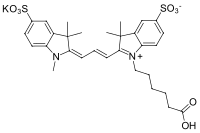
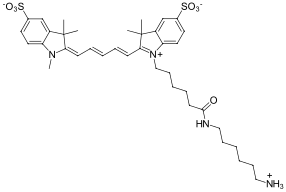

Sulfo-Cyanine3.5 azide is a water-soluble fluorescent dye that carries an azide group for click chemistry labeling. Its absorption and emission spectra lie between those of Cyanine3 and Cyanine5. In addition, four extra sulfo groups make the dye and its conjugates highly water soluble. As a result, researchers can label alkyne-modified biomolecules, small molecules, and polymers in aqueous solutions without adding organic solvents.
Key Features and Benefits
- Azide Reactive Group: The azide reacts with terminal alkynes and strained cycloalkynes, forming stable triazole linkages.
- Copper-Catalyzed Click Chemistry: The dye takes part in CuAAC reactions with terminal alkyne partners under copper(I) catalysis.
- Copper-Free SPAAC Compatibility: Strained cycloalkynes, such as DBCO or BCN, also react with the azide without any copper catalyst.
- Intermediate Spectral Position: Its absorption and emission fall between Cyanine3 and Cyanine5, therefore offering an additional option between these common dyes.
- High Water Solubility: Compared with Cyanine3.5, four additional sulfo groups give high solubility to the dye and its conjugates.
- Organic-Solvent-Free Labeling: Because the reagent dissolves in aqueous solutions, labeling reactions can proceed without organic cosolvents.
- Energy-Transfer Pairing: In FRET pairs, this fluorophore can act as either the donor or the acceptor.
Applications
- Click Chemistry Bioconjugation: The azide attaches the fluorophore to alkyne- or cycloalkyne-modified biomolecules through CuAAC or SPAAC.
- FRET and BRET Studies: Sulfo-Cyanine3.5 fluorophores are widely used in FRET and BRET energy-transfer experiments.
- Biomolecule Fluorescent Labeling: Similarly, azide dyes are widely used to label alkyne-tagged proteins, peptides, and oligonucleotides.
- Small Molecule and Polymer Labeling: The dye also conjugates to alkyne-bearing small molecules and polymers for fluorescent tracking.
- Copper-Free Labeling: For example, SPAAC avoids copper, which suits samples where copper ions may be undesirable.
Storage and Handling
- Storage: Store according to supplier specifications. As general practice for cyanine dyes, keep the vial tightly closed and protected from light and moisture.
- Handling: Let the vial reach room temperature before opening to limit condensation. Also, avoid phosphines and strong reducing agents, because these can reduce azides.
- Preparation: Dissolve the dye in aqueous buffer, since its sulfo groups support water solubility. Then prepare solutions shortly before use and shield them from light.
- Click Chemistry and Analysis: For CuAAC, generate copper(I) in situ, often with a stabilizing ligand; for SPAAC, omit copper. Afterward, remove free dye by gel filtration, dialysis, or HPLC, and check labeling by absorbance or fluorescence.
Sulfo-Cyanine3.5 azide combines an azide click handle with a sulfonated cyanine fluorophore that absorbs and emits between Cyanine3 and Cyanine5. Consequently, it suits CuAAC and copper-free SPAAC labeling of biomolecules, small molecules, and polymers in aqueous media, as well as energy-transfer studies.
AxisPharm offers 5000+ PEG Linkers with high purity. Different kinds of PEG Reagents may be available by custom synthesis.


