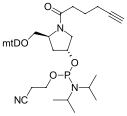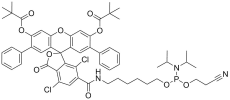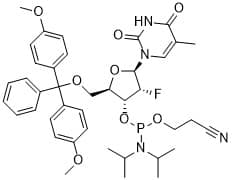
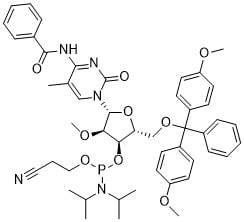

MMT-Hexylaminolinker Phosphoramidite provides a protected aminohexyl linker for introducing primary amine functionality into synthetic oligonucleotides and specifically combines a six-carbon alkyl spacer with a monomethoxytrityl (MMT)-protected amino group and a reactive phosphoramidite moiety. This reagent supports amino-modified DNA and RNA synthesis, fluorescent labeling, bioconjugation, and nucleic acid probe development.
Key Features and Benefits
- MMT-Protected Amino Group: Protects the primary amine during oligonucleotide synthesis and allows controlled deprotection for subsequent conjugation reactions.
- Six-Carbon Linker: Provides a flexible hexyl spacer that separates the amino functionality from the oligonucleotide backbone.
- Reactive Phosphoramidite Group: Supports incorporation into oligonucleotides specifically through standard phosphoramidite coupling chemistry.
- Primary Amine Functionalization: Generates an accessible amino group after deprotection for reactions with suitable electrophilic labeling and conjugation reagents.
- Flexible Molecular Spacer: Provides rotational flexibility that can reduce steric interference during downstream conjugation reactions.
- Controlled Deprotection: Uses acid-labile MMT protection to specifically facilitate amino group exposure under appropriately validated conditions.
- Bioconjugation Compatibility: Supports coupling with NHS esters, activated carboxyl derivatives, and other amine-reactive compounds.
- Automated Synthesis Compatibility: Can be incorporated using compatible solid-phase oligonucleotide synthesis protocols and suitable coupling conditions.
- Versatile Linker Design: Enables preparation of amino-functionalized oligonucleotides specifically for fluorescent labeling, immobilization, and molecular recognition studies.
Applications
- Amino-Modified Oligonucleotide Synthesis: Enables introduction of protected aminohexyl functionality into DNA and RNA oligonucleotides.
- Fluorescent Dye Conjugation: Supports attachment of NHS ester-activated fluorescent dyes to deprotected amino-modified oligonucleotides.
- Biotinylated Probe Development: Enables conjugation of amine-reactive biotin derivatives for affinity capture and detection applications.
- Nucleic Acid Probe Immobilization: Supports covalent attachment of amino-modified oligonucleotides to appropriately activated surfaces and solid supports.
- DNA and RNA Labeling: Facilitates post-synthetic incorporation of functional labels for molecular detection and analytical research.
- Biosensor Development: Enables preparation of functionalized nucleic acid probes for integration into biosensor platforms.
- Oligonucleotide Bioconjugation: Supports conjugation of synthetic nucleic acids with peptides, proteins, polymers, and other compatible molecules.
- Molecular Diagnostics Research: Enables development of labeled and immobilized oligonucleotide probes for nucleic acid recognition assays.
- Nucleic Acid Nanotechnology: Supports preparation of amino-functionalized DNA and RNA components for molecular assembly and surface modification studies.
Storage and Handling
- Storage: Store at −20°C in a tightly sealed container under dry, inert conditions, unless otherwise specified. Protect from moisture, heat, and prolonged exposure to light. Allow the sealed container to reach room temperature before opening to minimize condensation.
- Handling: Prepare solutions using anhydrous acetonitrile or another validated solvent compatible with phosphoramidite synthesis. Minimize exposure to atmospheric moisture because phosphoramidite groups are susceptible to hydrolysis.
- Use appropriate phosphoramidite activators and coupling conditions according to the oligonucleotide synthesis protocol. Confirm the intended linker incorporation position and ensure compatibility with the protecting groups used throughout synthesis.
- After synthesis, remove the MMT protecting group using validated deprotection conditions compatible with the oligonucleotide sequence and other modifications. For subsequent conjugation, react the exposed primary amine with a suitable amine-reactive reagent, such as an NHS ester, under optimized conditions.
- Verify successful linker incorporation and subsequent conjugation using appropriate analytical methods, such as HPLC and mass spectrometry.
MMT-Hexylaminolinker Phosphoramidite combines protected primary amine functionality with a flexible six-carbon spacer for oligonucleotide modification and bioconjugation research and specifically supports fluorescent labeling, biotin conjugation, nucleic acid immobilization, biosensor development, and functionalized DNA and RNA probe preparation.
AxisPharm offers 5000+ PEG Linkers with high purity. Different kinds of PEG Reagents may be available by custom synthesis.