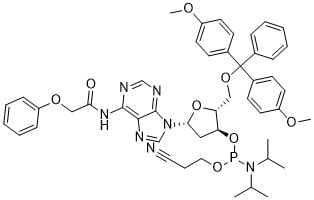
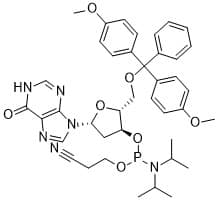
Inosine (dI) phosphoramidite provides a protected 2′-deoxyinosine building block for automated DNA oligonucleotide synthesis and nucleic acid research that specifically features a hypoxanthine nucleobase, a 5′-dimethoxytrityl (DMT) protecting group, and a 3′-O-(2-cyanoethyl N,N-diisopropylphosphoramidite) group. This structure specifically supports site-specific incorporation of deoxyinosine into synthetic DNA sequences for base-pairing, mutagenesis, and molecular biology studies.
Key Features and Benefits
- Deoxyinosine Nucleoside: Contains a hypoxanthine nucleobase attached to 2′-deoxyribose for incorporation into synthetic DNA oligonucleotides.
- Phosphoramidite Chemistry: Supports automated solid-phase DNA synthesis through standard phosphoramidite coupling cycles.
- 5′-DMT Protection: Features a dimethoxytrityl protecting group for controlled nucleotide addition specifically during stepwise oligonucleotide synthesis.
- 3′-Phosphoramidite Functionality: Provides a reactive phosphoramidite group for especially efficient coupling with growing oligonucleotide chains under suitable conditions.
- 2-Cyanoethyl Protection: Protects the phosphite-derived phosphate linkage during synthesis and supports subsequent deprotection.
- Hypoxanthine Base Functionality: Introduces a modified purine nucleobase capable of pairing with multiple complementary nucleobases under sequence-dependent conditions.
- Degenerate Base Incorporation: Supports preparation of oligonucleotides containing deoxyinosine at selected positions for hybridization and sequence recognition studies.
- Automated Synthesis Compatibility: Supports incorporation into DNA sequences specifically using compatible automated oligonucleotide synthesizers and validated coupling protocols.
- Versatile Research Applications: Enables investigation of nucleotide recognition, DNA polymerase activity, and modified nucleic acid structures.
Applications
- DNA Oligonucleotide Synthesis: Supports incorporation of deoxyinosine residues into synthetic DNA using solid-phase phosphoramidite chemistry.
- Degenerate Primer Design: Enables preparation of primers containing inosine at selected positions to accommodate nucleotide sequence variation.
- PCR Research: Supports development and evaluation of inosine-containing primers for amplification of genetically diverse sequences.
- DNA Hybridization Studies: Useful for investigating base-pairing behavior, duplex stability, and sequence-dependent hybridization properties.
- Mutagenesis Research: Supports preparation of modified DNA substrates for investigating nucleotide substitutions and mutational mechanisms.
- DNA Polymerase Studies: Enables evaluation of polymerase recognition, nucleotide incorporation, and extension across deoxyinosine-containing templates.
- Nucleic Acid Probe Development: Supports synthesis of modified DNA probes for sequence recognition and molecular detection research.
- DNA Repair Research: Useful for investigating the recognition and processing of hypoxanthine-containing DNA by repair enzymes.
- Modified Oligonucleotide Development: Supports preparation of DNA sequences containing noncanonical nucleobases for biochemical and molecular biology studies.
Storage and Handling
- Storage: Store at −20°C in a dry, tightly sealed container under an inert atmosphere when possible, unless otherwise specified. Protect from moisture, heat, and prolonged light exposure.
- Handling: Handle under anhydrous conditions to preserve phosphoramidite reactivity. Prepare solutions using dry, compatible solvents, such as anhydrous acetonitrile, when appropriate. Minimize exposure to atmospheric moisture and use freshly prepared solutions for oligonucleotide synthesis. Follow validated coupling, oxidation, and deprotection procedures.
Inosine (dI) phosphoramidite provides a protected deoxyinosine building block for precise incorporation into synthetic DNA oligonucleotides and specifically supports degenerate primer synthesis, nucleic acid hybridization, DNA polymerase studies, mutagenesis research, and development of modified DNA probes.
AxisPharm offers 5000+ PEG Linkers with high purity. Different kinds of PEG Reagents may be available by custom synthesis.