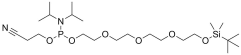
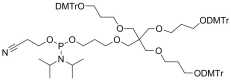
DusQ1 amidite, 5′-terminal is a phosphoramidite reagent for adding a DusQ1 group to the 5′-end of synthetic oligonucleotides. As the name indicates, it couples at the 5′-terminal position during solid-phase synthesis. Because it uses phosphoramidite chemistry, the modification can join the standard chain assembly cycle. As a result, researchers can prepare 5′-modified oligonucleotides without a separate post-synthetic labeling step.
Key Features and Benefits
- Phosphoramidite Reactive Group: After activation, phosphoramidites couple to the free 5′-hydroxyl of a support-bound oligonucleotide chain.
- 5′-Terminal Placement: The reagent targets the 5′-end, so it typically serves as the final coupling in a sequence.
- DusQ1 Moiety: After coupling, oxidation and deprotection, the DusQ1 group remains attached to the finished oligonucleotide.
- Synthesis Cycle Compatibility: Phosphoramidite modifiers generally fit standard solid-phase cycles, so modification happens during chain assembly.
- Flexible Pack Sizes: In addition, the reagent comes in 100 mg, 250 mg, 500 mg, 1 g and 5 g units.
Applications
- Oligonucleotide Synthesis: Researchers incorporate the DusQ1 group at the 5′-terminus during solid-phase oligonucleotide assembly.
- 5′-End Modification: Similarly, 5′-terminal phosphoramidites are widely used to build end-modified primers and oligonucleotides.
- Modified Probe Preparation: In general, 5′-modifier phosphoramidites help chemists prepare labeled oligonucleotide probes for hybridization-based research.
Storage and Handling
- Storage: Store according to supplier specifications. Phosphoramidites generally need protection from moisture and air.
- Handling: Let the vial reach room temperature before opening to limit condensation. Phosphoramidites hydrolyze and oxidize readily, so work under dry, inert conditions.
- Preparation: Dissolve the reagent in an anhydrous solvent suited to phosphoramidite coupling, as confirmed by supplier guidance. Then use the solution promptly.
- Coupling and Analysis: Confirm coupling time and deprotection conditions for DusQ1 compatibility before synthesis. Afterward, chemists typically verify products by chromatographic and mass spectrometric analysis.
In summary, DusQ1 amidite, 5′-terminal provides phosphoramidite chemistry for introducing the DusQ1 group at the 5′-end of oligonucleotides. It also fits standard solid-phase synthesis workflows. Therefore, it supports the preparation of 5′-modified oligonucleotides and probes for research.
AxisPharm offers 5000+ PEG Linkers with high purity. Different kinds of PEG Reagents may be available by custom synthesis.