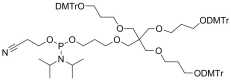



DMT-dG(dmf) Phosphoramidite is a protected deoxyguanosine nucleotide building block designed for solid-phase DNA synthesis and oligonucleotide research. It features a 5′-dimethoxytrityl (DMT) protecting group, an N²-dimethylformamidine (dmf) guanine protecting group, and a reactive 3′-phosphoramidite functionality. The dmf protecting group supports faster deprotection than conventional isobutyryl-protected deoxyguanosine under suitable conditions. Additionally, its compatibility with phosphoramidite synthesis chemistry enables efficient incorporation of guanine residues into synthetic DNA sequences.
Key Features and Benefits
- Protected Deoxyguanosine Building Block: Provides a protected 2′-deoxyguanosine nucleoside for incorporation into synthetic DNA oligonucleotides.
- 5′-DMT Protecting Group: Protects the 5′-hydroxyl group during synthesis while allowing controlled removal during successive oligonucleotide assembly cycles.
- N²-Dimethylformamidine Protection: Protects the guanine exocyclic amino group and supports faster deprotection than conventional isobutyryl protection under compatible conditions.
- Reactive 3′-Phosphoramidite Group: Enables efficient nucleotide coupling through established phosphoramidite chemistry.
- Fast Deprotection Capability: Specifically facilitates rapid removal of the guanine protecting group using suitable ammonium hydroxide or other validated deprotection procedures.
- Solid-Phase DNA Synthesis Compatibility: Supports automated and manual oligonucleotide synthesis using compatible phosphoramidite coupling protocols.
- Guanine-Rich Sequence Synthesis: Helps reduce incomplete guanine deprotection in G-rich oligonucleotides compared with conventional isobutyryl-protected monomers.
- High-Throughput Synthesis Potential: Supports efficient oligonucleotide production by reducing deprotection time under appropriately optimized conditions.
- Nucleic Acid Research Versatility: Additionally, provides a protected guanine building block for DNA probe development, molecular biology research, and synthetic nucleic acid applications.
Applications
- Solid-Phase DNA Oligonucleotide Synthesis: Enables incorporation of deoxyguanosine residues into synthetic DNA sequences using phosphoramidite chemistry.
- Automated Oligonucleotide Synthesis: Supports preparation of DNA oligonucleotides using compatible automated synthesis platforms.
- Guanine-Rich DNA Synthesis: Specifically supports synthesis of G-rich sequences where efficient guanine deprotection is important for product quality.
- DNA Probe Development: Enables preparation of synthetic DNA probes for hybridization, molecular detection, and sequence recognition studies.
- PCR Primer Synthesis: Supports production of DNA primers for polymerase chain reaction and other nucleic acid amplification applications.
- Fast-Deprotection Oligonucleotide Synthesis: Facilitates preparation of synthetic DNA using compatible rapid cleavage and deprotection procedures.
- Antisense Oligonucleotide Research: Provides a guanine building block for preparing compatible DNA-containing antisense sequences and related research oligonucleotides.
- DNA Structure and Interaction Studies: Additionally, supports synthesis of guanine-containing sequences for investigating DNA structure, molecular recognition, and nucleic acid interactions.
- Nucleic Acid Assay Development: Enables preparation of synthetic DNA sequences for analytical assays, molecular detection, and biotechnology research.
Storage and Handling
- Storage: Store at −20°C in a dry, tightly sealed container, protected from moisture and heat. Additionally, minimize temperature fluctuations to preserve phosphoramidite reactivity.
- Handling: Use clean, dry equipment and appropriate protective gear. Prepare solutions in anhydrous acetonitrile or another validated synthesis solvent under moisture-controlled conditions.
- Oligonucleotide Synthesis: Incorporate into DNA sequences using compatible solid-phase phosphoramidite coupling protocols. Subsequently, optimize coupling and oxidation conditions to maintain synthesis efficiency.
- Deprotection and Analysis: Apply compatible cleavage and deprotection procedures to remove DMT, dmf, and phosphate protecting groups as appropriate. Evaluate oligonucleotide purity and integrity using HPLC, LC-MS, or other validated analytical methods.
DMT-dG(dmf) Phosphoramidite combines protected deoxyguanosine chemistry with reactive phosphoramidite functionality for efficient DNA synthesis. Its dimethylformamidine protecting group supports rapid deprotection under compatible conditions while reducing incomplete guanine deprotection. Therefore, it supports automated oligonucleotide synthesis, G-rich DNA preparation, molecular probe development, and nucleic acid research.
AxisPharm offers 5000+ PEG Linkers with high purity. Different kinds of PEG Reagents may be available by custom synthesis.