

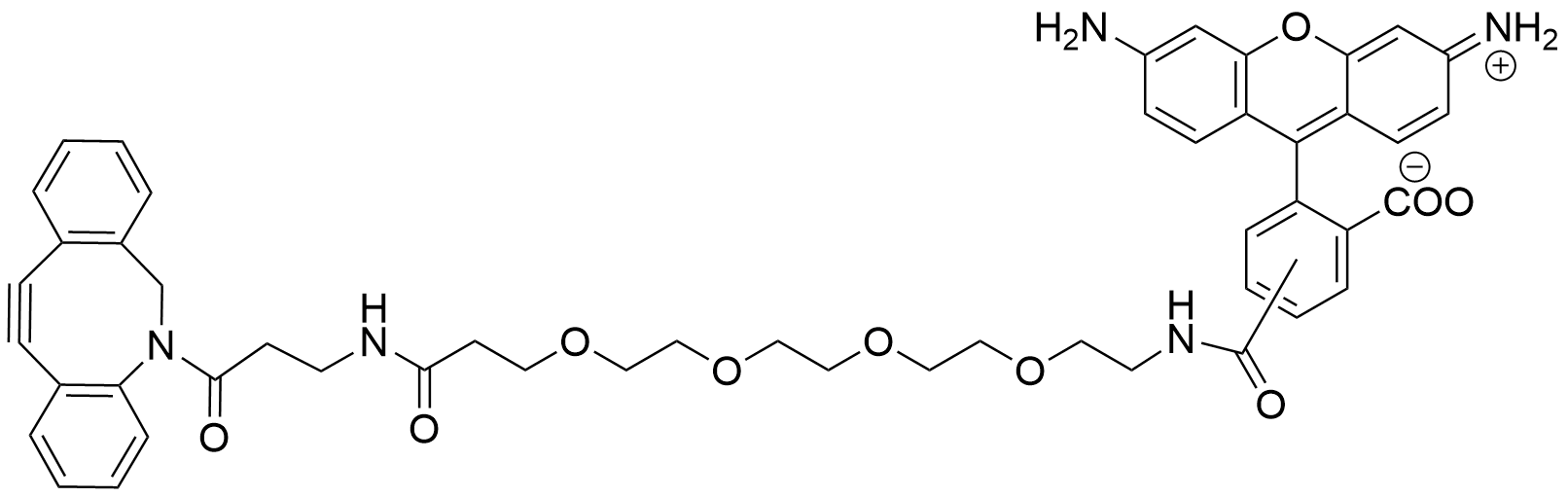


DBCO-mPEG, MW 30K is a monofunctional PEGylation reagent with a dibenzocyclooctyne (DBCO) group on one end of a methoxy-terminated PEG chain. The DBCO group reacts with azides through copper-free click chemistry and forms a stable triazole linkage. Because the reaction needs no copper catalyst or elevated temperature, the reagent suits workflows where copper is a concern. In general, researchers use DBCO-PEG reagents to PEGylate azide-tagged biomolecules, surfaces, and nanoparticles.
Key Features and Benefits
- DBCO Reactive Group: The strained cyclooctyne reacts with azides without a copper catalyst or elevated temperatures.
- Stable Triazole Linkage: As a result, the click reaction joins the PEG chain to the azide partner through a stable triazole.
- Methoxy-Capped Terminus: The mPEG end carries no reactive group, so the reagent acts as a monofunctional PEGylation agent.
- MW 30K PEG Chain: In general, long PEG chains increase the hydrodynamic size of the molecules they modify.
- Copper-Free Chemistry: Because the reaction avoids copper, it offers an alternative to copper-catalyzed alkyne–azide coupling.
- Hydrophilic Polymer: PEG is a water-soluble polymer, which can also improve the solubility of conjugated molecules.
Applications
- Copper-Free Click PEGylation: DBCO-PEG reagents attach PEG chains to azide-modified molecules when copper must be avoided.
- Protein and Peptide Conjugation: In addition, DBCO-PEG reagents react with azide-tagged proteins and peptides to form PEGylated conjugates.
- Surface Functionalization: Similarly, DBCO-PEG reagents graft PEG chains onto azide-functionalized surfaces and materials.
- Nanoparticle and Liposome Modification: Researchers also use DBCO-PEG reagents to PEGylate azide-bearing nanoparticles and liposomes.
- Drug Delivery Research: For example, PEGylation with long PEG chains is a common strategy in drug carrier studies.
Storage and Handling
- Storage: Store according to supplier specifications in a tightly sealed container, protected from moisture and light.
- Handling: As general practice, let the vial reach room temperature before opening to limit moisture condensation.
- Preparation: Choose a solvent compatible with PEG and the azide partner, and avoid buffers containing sodium azide.
- Click Reaction and Analysis: Run reactions under mild conditions, then purify by size-exclusion chromatography or dialysis and confirm PEGylation by SDS-PAGE.
DBCO-mPEG, MW 30K combines a reactive DBCO end group with a methoxy-capped PEG chain. It supports copper-free click PEGylation of proteins, peptides, surfaces, and nanoparticles. Consequently, it fits bioconjugation workflows that require mild, catalyst-free conditions.
AxisPharm offers 5000+ PEG Linkers with high purity. Different kinds of PEG Reagents may be available by custom synthesis.


