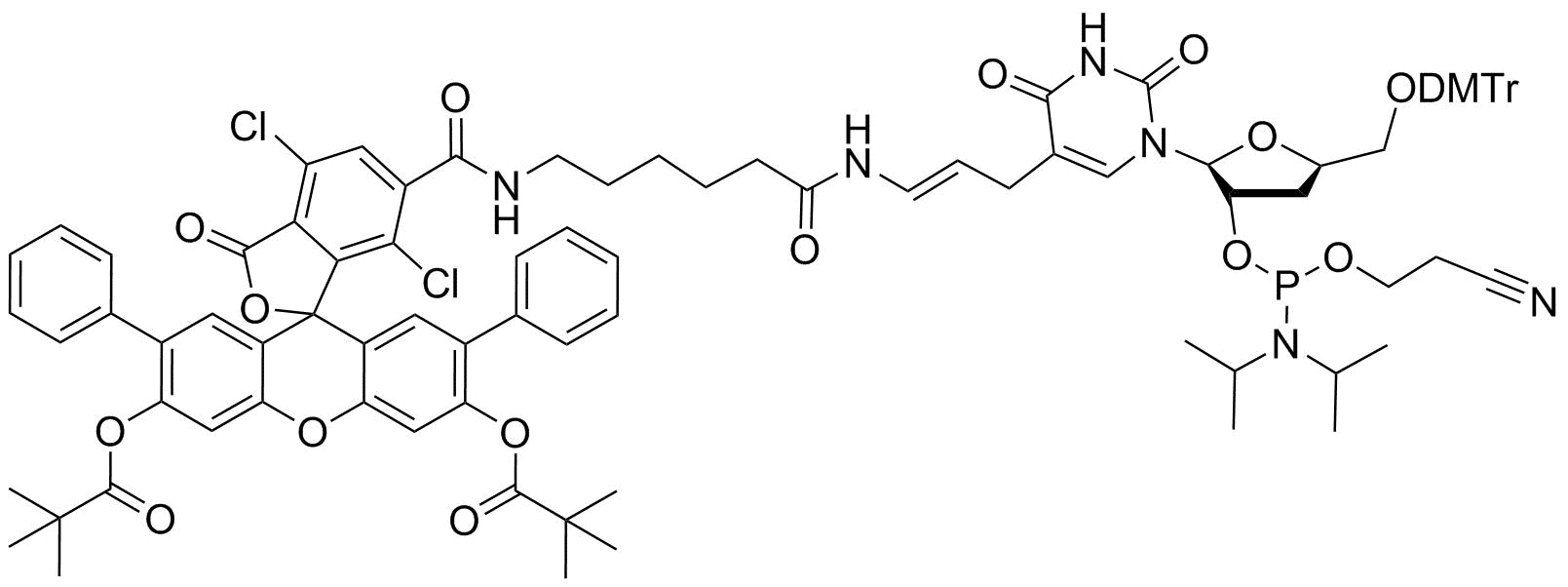



Cyanine 3 (Cy3) Phosphoramidite provides a fluorescent nucleotide-labeling reagent for solid-phase oligonucleotide synthesis and nucleic acid research and specifically combines a Cy3 fluorescent dye with reactive phosphoramidite functionality for covalent incorporation into synthetic oligonucleotides. Its orange-red fluorescence specifically supports DNA and RNA labeling, molecular detection, fluorescence imaging, and nucleic acid interaction studies.
Key Features and Benefits
- Cyanine 3 Fluorophore: Provides orange-red fluorescence with typical excitation near 550 nm and emission near 570 nm.
- Reactive Phosphoramidite Group: Enables covalent incorporation of the fluorescent dye into oligonucleotides through established phosphoramidite coupling chemistry.
- Oligonucleotide Labeling Capability: Supports preparation of fluorescently labeled DNA and compatible RNA sequences for molecular biology research.
- Solid-Phase Synthesis Compatibility: Enables integration into suitable automated and manual oligonucleotide synthesis workflows.
- Covalent Dye Incorporation: Forms a stable phosphite linkage during coupling that undergoes oxidation to produce a phosphate-containing linkage.
- Fluorescence Detection Compatibility: Supports analysis using fluorescence instruments equipped with appropriate Cy3 excitation and emission settings.
- Sequence Labeling Versatility: Enables fluorescent modification at positions supported by the reagent’s specific structure and synthesis protocol.
- Molecular Probe Development: Supports preparation of fluorescent oligonucleotide probes for hybridization, detection, and molecular interaction studies.
- Nucleic Acid Research Applications: Provides a fluorescent building block for investigating nucleic acid structure, binding, and molecular behavior.
Applications
- Fluorescent DNA Oligonucleotide Synthesis: Enables incorporation of Cy3 labels into synthetic DNA sequences through compatible phosphoramidite chemistry.
- RNA Oligonucleotide Labeling: Supports preparation of fluorescent RNA probes using validated RNA synthesis and deprotection procedures.
- Fluorescence In Situ Hybridization: Enables development of Cy3-labeled oligonucleotide probes for investigating nucleic acid localization and sequence recognition.
- Molecular Beacon Development: Supports preparation of fluorescent oligonucleotide probes for studying hybridization and nucleic acid detection.
- Fluorescence Resonance Energy Transfer: Enables development of FRET-based nucleic acid probes when paired with suitable fluorescent acceptors.
- Nucleic Acid Hybridization Studies: Supports preparation of labeled probes for investigating complementary DNA and RNA interactions.
- Fluorescence Microscopy: Enables synthesis of fluorescent oligonucleotide probes for imaging nucleic acids in compatible experimental systems.
- Oligonucleotide Tracking: Supports fluorescent labeling of synthetic nucleic acids for studying molecular distribution, binding, and cellular uptake.
- Nucleic Acid Assay Development: Provides a fluorescent labeling reagent for developing analytical assays and sequence-specific detection methods.
Storage and Handling
- Storage: Store at −20°C in a dry, tightly sealed container, protected from light and moisture. Follow product-specific storage instructions when available. Minimize repeated exposure to atmospheric humidity to preserve phosphoramidite reactivity.
- Handling: Handle using clean, dry equipment under moisture-controlled conditions. Prepare solutions in anhydrous acetonitrile or another validated synthesis solvent. Confirm solubility and compatibility with the selected oligonucleotide synthesis system.
- Incorporate the Cy3 phosphoramidite into oligonucleotides using compatible solid-phase phosphoramidite synthesis protocols. Optimize reagent concentration, coupling time, and activation conditions for efficient dye incorporation. Protect the reagent from moisture because phosphoramidite groups undergo hydrolysis.
- Select the appropriate synthesis cycle and labeling position according to the specific phosphoramidite structure. Some Cy3 phosphoramidites support terminal labeling, while others accommodate internal incorporation. Confirm the reagent’s linker design and protecting groups before selecting synthesis conditions.
- Evaluate coupling efficiency, fluorescence intensity, oligonucleotide integrity, and final product purity using appropriate analytical techniques. Apply compatible cleavage and deprotection procedures to preserve dye functionality. Purify labeled oligonucleotides through HPLC or another validated method when necessary. Avoid excessive light exposure and harsh chemical conditions. Confirm the exact dye structure, spectral properties, and product specifications before use.
Cyanine 3 (Cy3) Phosphoramidite combines orange-red fluorescence with phosphoramidite chemistry for covalent oligonucleotide labeling and specifically supports fluorescent DNA and RNA synthesis, molecular probe development, nucleic acid detection, and fluorescence-based research.
AxisPharm offers 5000+ PEG Linkers with high purity. Different kinds of PEG Reagents may be available by custom synthesis.