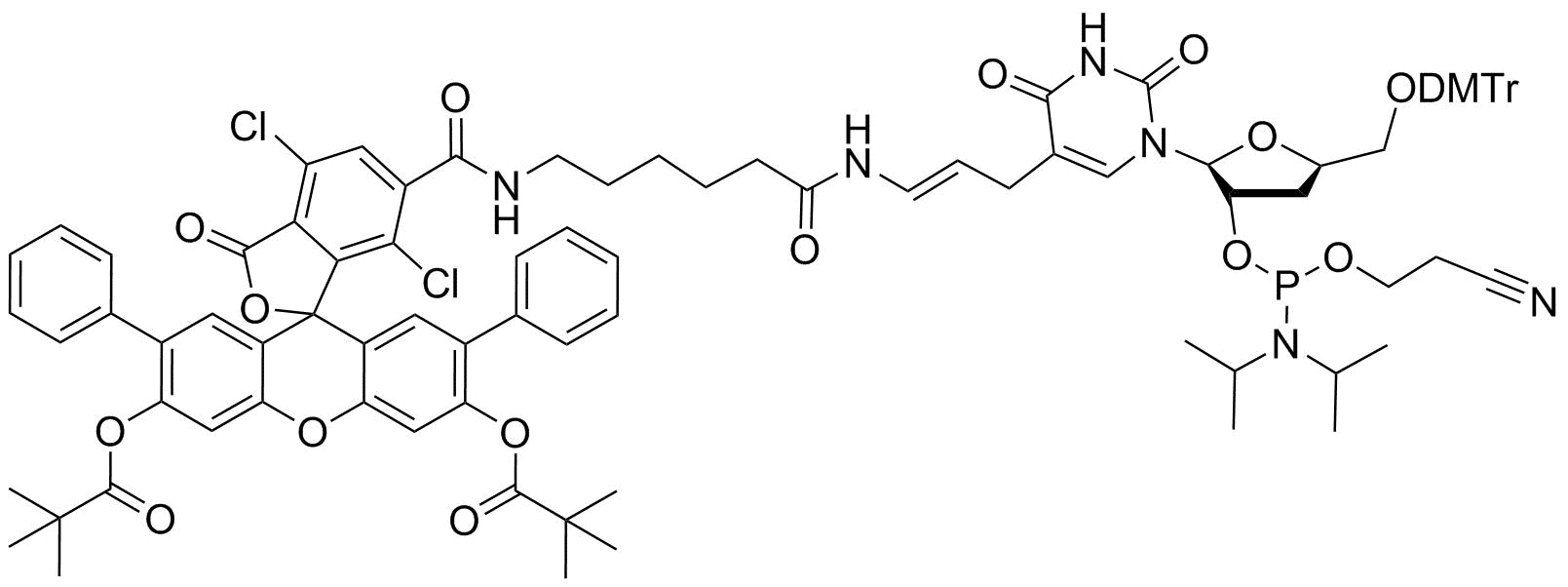
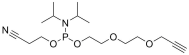
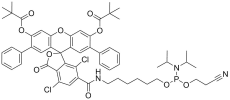
Biotin phosphoramidite (hydroxyprolinol) is a non-nucleosidic modifier reagent for synthesizing biotinylated oligonucleotides. Its structure carries biotin on a hydroxyprolinol core rather than on a nucleoside. In addition, a dimethoxytrityl (DMT) protective group supports purification of the resulting oligos on C18 cartridges and by reverse phase HPLC. As a result, researchers can introduce biotin at the 5′ end, the 3′ end, or internal positions during oligonucleotide synthesis.
Key Features and Benefits
- Hydroxyprolinol Core: Biotin attaches through a non-nucleosidic hydroxyprolinol scaffold instead of a natural nucleoside.
- Flexible Label Placement: The reagent introduces biotin at 5′ and internal sites, and also at the 3′ end using universal CPG.
- DMT Protective Group: The dimethoxytrityl group enables purification on C18 cartridges and by reverse phase HPLC.
- Standard Synthesis Conditions: The amidite needs no special coupling or deprotection conditions, so it fits routine protocols.
- Phosphoramidite Chemistry: Like other phosphoramidites, it couples to a free hydroxyl on the growing chain after activation.
- Biotin Affinity Tag: Biotin binds avidin and streptavidin strongly, therefore biotinylated oligos commonly serve as capture handles.
Applications
- Biotinylated Oligo Synthesis: The reagent adds biotin to oligonucleotides at terminal or internal positions.
- Oligonucleotide Purification: In turn, the DMT group supports cartridge and reverse phase HPLC purification of labeled oligos.
- Affinity Capture: Biotinylated oligonucleotides are widely used to capture nucleic acid targets on streptavidin beads or surfaces.
- Probe Detection: Similarly, biotin-labeled probes are often paired with streptavidin conjugates in hybridization assays.
- Surface Immobilization: Biotinylated oligos also allow attachment of nucleic acids to streptavidin-coated supports.
Storage and Handling
- Storage: Store according to supplier specifications; as general practice, keep phosphoramidites dry and protected from air.
- Handling: Let the vial reach room temperature before opening, because condensation can hydrolyze phosphoramidites.
- Preparation: Dissolve in an anhydrous solvent suited to your synthesizer; anhydrous acetonitrile is typical for phosphoramidites.
- Synthesis and Analysis: Apply standard coupling and deprotection, then purify DMT-on and confirm products by HPLC or mass spectrometry.
Biotin phosphoramidite (hydroxyprolinol) combines a hydroxyprolinol core, a biotin label, and a DMT group in one modifier reagent. It supports biotinylation at 5′, 3′, and internal oligo sites under standard conditions. Consequently, it fits routine workflows for preparing biotin-labeled oligonucleotides for capture and detection studies.
AxisPharm offers 5000+ PEG Linkers with high purity. Different kinds of PEG Reagents may be available by custom synthesis.