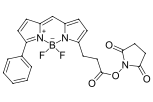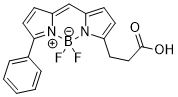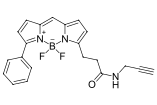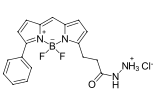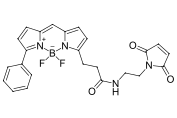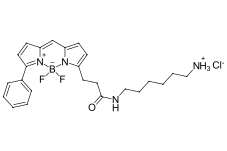
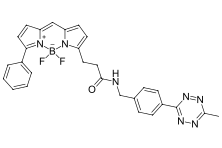
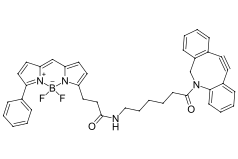
BDP R6G DBCO is a fluorescent click chemistry reagent that combines a BDP R6G fluorophore with a DBCO strained cyclooctyne. BDP stands for borondipyrromethene, a versatile dye scaffold tuned here to match the absorption and emission of Rhodamine 6G (R6G). The DBCO group reacts with azides without a catalyst, forming stable triazoles. As a result, researchers can prepare fluorescent conjugates and visualize azide groups on biomolecules and surfaces.
Key Features and Benefits
- BDP R6G Fluorophore: The borondipyrromethene core matches the absorption and emission of Rhodamine 6G.
- Bright, Photostable Signal: In addition, BDP R6G serves as a bright and photostable substitute for R6G.
- DBCO Reactive Group: This strained cyclic alkyne reacts rapidly with azides to give stable triazole linkages.
- Catalyst-Free Click Chemistry: Because the cycloaddition needs no catalyst, labeling avoids copper-based reaction steps.
- Functional Group Tolerance: The reaction also tolerates most biologically important functional groups.
- Flexible Pack Sizes: Units from 1 mg to 100 mg support both pilot reactions and larger labeling runs.
Applications
- Fluorescent Conjugate Synthesis: The DBCO handle couples the dye to azide-bearing molecules to build fluorescent conjugates.
- Azide Visualization on Biomolecules: Researchers can detect azide groups bound to biomolecules through direct fluorescent tagging.
- Surface Labeling: Similarly, the dye marks azide-functionalized surfaces for fluorescent visualization.
- Copper-Free Bioconjugation: DBCO dyes are widely used to label azide-modified proteins, peptides, and nucleic acids.
- R6G Replacement: Because its spectra match R6G, BDP R6G suits workflows originally designed around Rhodamine 6G.
Storage and Handling
- Storage: Store according to supplier specifications; as general practice, keep fluorescent dyes sealed and protected from light and moisture.
- Handling: Allow the vial to reach room temperature before opening, then minimize light exposure during weighing.
- Preparation: Choose a solvent compatible with both the dye and the azide partner, following supplier documentation.
- Click Chemistry and Analysis: Avoid sodium azide in buffers, since free azide consumes DBCO; then purify conjugates and confirm labeling by absorbance or fluorescence.
BDP R6G DBCO pairs an R6G-matched borondipyrromethene fluorophore with a catalyst-free, azide-reactive DBCO group. Researchers can therefore synthesize fluorescent conjugates and visualize azide-tagged biomolecules and surfaces. It fits copper-free click labeling workflows that call for a bright, photostable alternative to Rhodamine 6G.
AxisPharm offers 5000+ PEG Linkers with high purity. Different kinds of PEG Reagents may be available by custom synthesis.