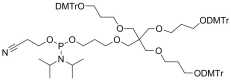
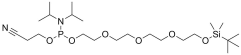
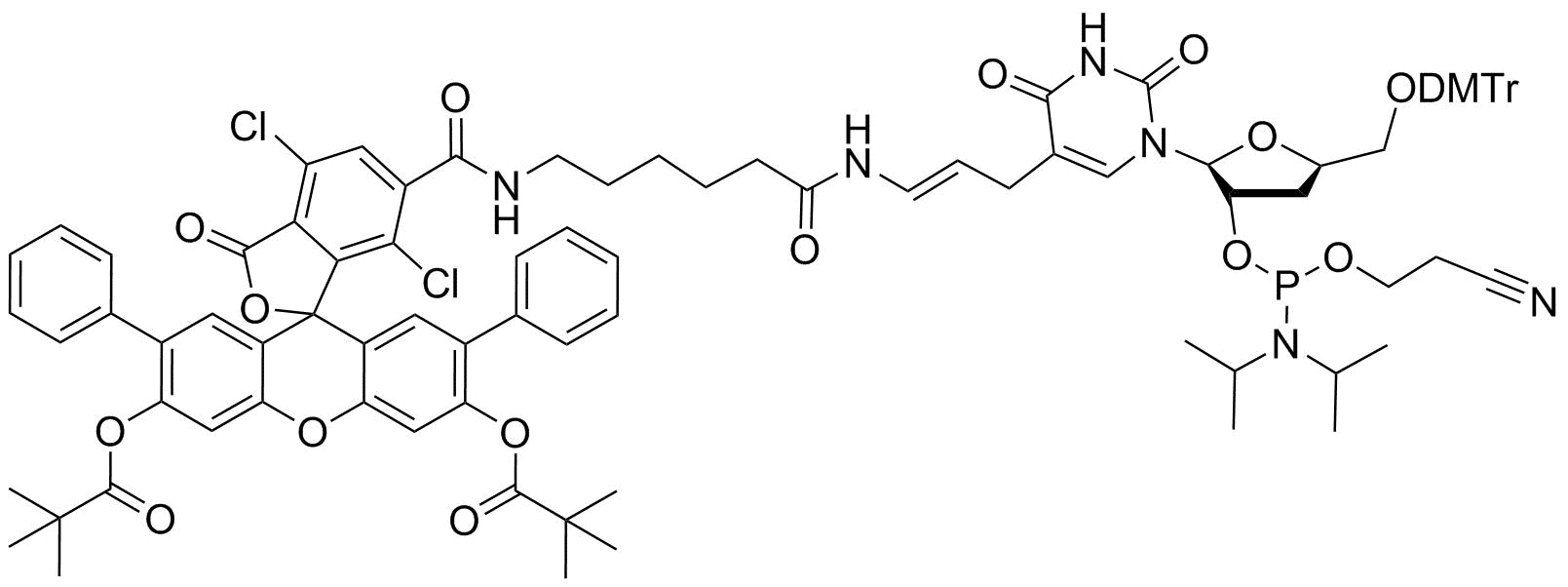
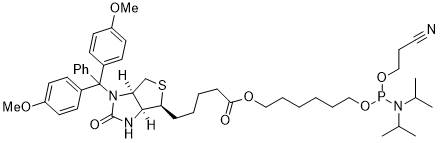
DusQ1 dT phosphoramidite is a modified nucleoside phosphoramidite for the solid-phase synthesis of DNA oligonucleotides. It combines a deoxythymidine (dT) nucleoside, a reactive phosphoramidite group, and a DusQ1 modification group. As a result, researchers can place a DusQ1-modified dT at defined positions within a synthetic DNA strand. AxisPharm describes the DusQ1 group as a modification developed to enhance the hybridization properties of oligonucleotides.
Key Features and Benefits
- Deoxythymidine Scaffold: The dT nucleoside places the modification at a thymidine position within the DNA sequence.
- Phosphoramidite Group: In general, activated phosphoramidites couple to the free 5′-hydroxyl of the growing oligonucleotide chain.
- DusQ1 Modification: According to AxisPharm, this group is intended to improve hybridization properties and target specificity of the oligonucleotide.
- Site-Specific Incorporation: Because the reagent enters during chain assembly, researchers control the position and number of modified residues.
- Synthesis Cycle Compatibility: Phosphoramidite reagents typically follow the coupling, capping, oxidation, and detritylation cycle of automated DNA synthesis.
- Pack Sizes: The reagent is also offered in 100 mg, 500 mg, and 1 g units.
Applications
- Modified Oligonucleotide Synthesis: Researchers incorporate DusQ1-dT residues into custom DNA sequences during solid-phase synthesis.
- PCR Research: Modified primers and probes containing DusQ1-dT may support PCR studies that depend on specific target binding.
- DNA Sequencing Research: Similarly, DusQ1-modified oligonucleotides can serve in sequencing workflows where accurate sequence targeting matters.
- Hybridization Studies: In addition, comparing modified and unmodified strands helps researchers assess how the DusQ1 group affects duplex formation.
- Gene Editing Research: Custom modified oligonucleotides also feature in gene editing studies that require sequence-specific targeting.
Storage and Handling
- Storage: Store according to supplier specifications. In general, keep phosphoramidites dry, tightly sealed, and protected from air.
- Handling: Allow the vial to reach room temperature before opening to limit condensation. Phosphoramidites hydrolyze and oxidize readily, so anhydrous, inert conditions are standard practice.
- Preparation: Phosphoramidites are commonly dissolved in anhydrous acetonitrile for synthesizer use. However, confirm the diluent and coupling time for this modified reagent with supplier guidance.
- Synthesis and Analysis: Check that cleavage and deprotection conditions are compatible with the DusQ1 group. Then characterize the oligonucleotide by HPLC, PAGE, or mass spectrometry.
DusQ1 dT phosphoramidite provides a direct route to DusQ1-modified thymidine residues in synthetic DNA. Its phosphoramidite chemistry fits standard oligonucleotide synthesis workflows. Consequently, it suits research on modified primers, probes, and hybridization-dependent applications such as PCR and DNA sequencing.
AxisPharm offers 5000+ PEG Linkers with high purity. Different kinds of PEG Reagents may be available by custom synthesis.